Is This Beef or Lamb in Standard Arabic
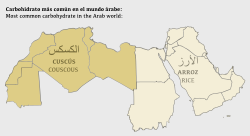
Arab cuisine (Arabic: المطبخ العربي) is the cuisine of the Arabs, defined every bit the various regional cuisines spanning the Arab world, from the Maghreb to the Fertile Crescent and the Arabian Peninsula.[1] These cuisines are centuries onetime and reflect the culture of trading in Baharat (spices), herbs, and foods. The regions have many similarities, merely also unique traditions. They have too been influenced past climate, cultivation, and mutual commerce.
Medieval cuisine [edit]
Breads [edit]
The white staff of life barazidhaj was made with high-quality wheat flour, similar to raqaq breadstuff but thicker, the fermented dough was leavened usually with yeast and "baker's borax" ( buraq ) and baked in a tandoor. One poetic poetry describing this bread:[2]
"In the uttermost end of Karkh of Baghdad, a bakery I saw offering bread, splendidly marvelous.
From purest essence of wheat contrived. Radiant and absolute, you may see your image reflected, crystal clear.
Barazij rounds glowing with lovely whiteness, more playful than gorgeous singing girls,
They wait like crystal trays, and were they indeed so, they would have served u.s. as plates.
Raqaq bread was made in two varieties, labiq (soft, thin flatbreads) and jarmazaj (dry out, thin bread flavored with tamarisk seeds).
Sauces [edit]
Numerous recipes for sauces ( sibagh ) have survived from historic Standard arabic cookbooks. The 10th-century Kitab al-Tabikh written by Ibn Sayyar al-Warraq gives several recipes to be served with roasted fish, attributed to the various sources.
To Ibrahim ibn al-Mahdi are credited 2 sibagh recipes, one prepared by adding rue, caraway, thyme, asafetida and cassia to the mustard sauce, and some other made past mashing vinegar-soaked raisins with garlic, walnut, mustard, vinegar, and seasonings like asafetida and anise.
From the seventh Abbasid caliph Al-Ma'mun'due south recipe collection comes a sibagh made with whey, walnut, garlic, olive oil and murri.
There are similar recipes meant for poultry dishes prepared with seasonings like ginger, pomegranate, spikenard, and cloves.
A surviving poem about sibagh is attributed to Caliph Al-Mu'tamid:[3]
The concept of sibagh is so subtle that none other than the smart tin can fathom.
Walnut and garlic with yogurt whey are the most you may need for information technology.
Or make it with vinegar, mahrut , and coriander. Only with anjudhan it will be even better.
If not, then mustard and garlic mixed with anjudhan and onion, equal parts, volition brand your savour.
Or with just vinegar and onion consume your fish and it will still be a tasty dish.
Sweets [edit]
Described equally the "food of kings" and "supreme judge of all sweets", lauzinaj was an almond-based confection that had entered medieval European cuisine by the 13th-century from Andalusian influence, returning Crusaders and Latin translations of cookery books. There are 2 versions of the dish known from medieval texts:[4]
- Lauzinaj mugharraq or "drenched lauzinaj ", this dish is believed to be an earlier version of the Ottoman dish baklava. It was fabricated by filling thin pastry dough with a mixture of ground almond (and sometimes other nuts like pistachio or walnut), rose water, and sometimes luxury flavorings like mastic, ambergris, or musk.
- Lauzinaj yabis was made with ground almonds cooked in boiling honey or sugar until reaching a taffy-similar consistency. The raw version, closer to marzipan in consistency, was made by blending the almonds with sugar and flavoring with camphor, musk, and rose water. The finished confection was molded into beast or other shapes, or cutting into squares and triangles.
Vegetables [edit]
Vegetables include leeks, endive, melilot, fenugreek, onions, purslane, Jew's mallow and radish.[5] Boiled asparagus is served with olive oil and murri. The cooking water may exist sweetened with honey and seasoned with cilantro, rue, anise and black pepper, and used every bit a drinkable either by itself with honey, or added to wine.[6]
Some vegetables are consumed raw, but the following are unremarkably boiled: asparagus, cauliflower, white soy beans, leeks, orach, a variety of mushroom known as ghushina [ description needed ], chard, cabbage, carrot, turnip, fresh fennel and eggplant.[7]
Some vegetable dishes are served cold. 1 instance of such a dish is eggplant with fried onion, fresh herbs and olive oil dressed with fermented sauces, vinegar and caraway. There are several cold eggplant dishes that are similar, some fabricated with smoked eggplant, adding basics like footing walnuts or almonds, and sometimes different seasonings like saffron, cassia, and galangal.
A dish for fried carrots with fresh herbs, dressing and spices was described by the poet Kushajim:[8] [9]
Dinars of carnelian and golden in a vessel and so delicate, it may almost melt and flow.
All radiating with luster like carnelian shimmering on pearls.
In the vessel harmoniously combined, hither together and in that location disperse.
The spices emitting fragrance like vino mingled with sweet breeze.
On top are pearls and silvery decked with gems,
Which the melt delicately fashioned, a gorgeous dish with flavor and perfume.
The scattered rue is flowers of turquoise gems, vibrantly green,
Jiggling with murri and olive oil, ebbing and flowing with sheen.
Diet and foods [edit]
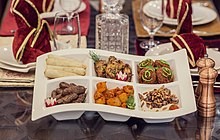
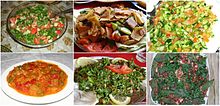
Arab cuisine uses specific and unique foods and spices. Some of those foods are:
- Meat—lamb and chicken are the well-nigh used, followed past beef and goat. Other poultry is used in some regions, and fish is used in coastal areas including the Mediterranean Body of water, Atlantic Sea and the Red Sea.
- Pork Some Christian Arabs swallow pork.[10]
- Dairy products—widely used, specially yogurt, buttermilk and white cheese. Butter and foam are as well used extensively.
- Herbs and spices—amounts and types used generally varies from region to region.
- Herbs and spices include: sesame, saffron, blackness pepper, allspice, turmeric, garlic, cumin, cinnamon, parsley, coriander and sumac.
- Spice mixtures include baharat, ras el hanout, za'atar, and harissa.
- Beverages—hot beverages are served more than often than cold, java being at the tiptop of the listing in Centre-Eastern countries and tea at summit in Maghreb countries.
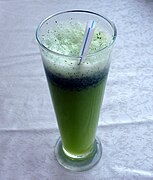
- In Jordan, Palestine, Egypt, some parts of Syria, Kingdom of morocco, and Algeria, tea is much more prevalent every bit a drink. Other Arabic drinks include Andalucian horchata and Maghrebi avocado smoothie.
- Grains—rice is the staple and is used for nearly dishes; wheat is the main source for breadstuff. Bulgur and semolina are also used extensively.
- Co-ordinate to celebrated recipes known from Standard arabic cookbooks, grains were primarily used to make porridge and pasta type dishes in Arab cuisine until the twelfth century. Two types of pasta were known: itriya, a short dry noodle of Greek origin similar to orzo, and rishta , a mitt-cut fresh noodle of Persian origin.
- By the 13th century, the Turkic style tutmaj and salma noodles had entered the cuisine.[11]
- Legumes—lentils are widely used in all colours, as well as fava beans, peanuts, chickpeas (garbanzo beans), scarlet runner beans, green peas, lupini beans, white beans, and chocolate-brown beans.
- Vegetables—popular vegetables in Arab cuisine include carrots, eggplant (aubergine), zucchini (courgette), artichokes, okra, onions, and olives. Potatoes are also eaten as vegetables in Arab civilisation.
- Fruits—pomegranate, dates, figs, oranges, citruses, watermelons, cantaloupe, honeydew melon, grapes, peaches, and nectarines are favored in Arab cuisine.
- Nuts—almonds, pine nuts, pistachios, and walnuts are often included in dishes or eaten as snacks.
- Greens—parsley, coriander and mint are popular as seasonings in many dishes, while spinach and mulukhiyah (leaves from the plant of the Corchorus genus) are used in cooked dishes.
- Dressings and sauces—the virtually popular dressings include various combinations of olive oil, lemon juice, parsley, or garlic, also as tahini (sesame paste). Labaneh (strained yogurt) is ofttimes seasoned with mint, onion, or garlic, and served equally a sauce with diverse dishes.
Structure of meals [edit]
There are ii basic structures for meals in the Arab World, 1 regular schedule during most of the twelvemonth and a 2d one that is unique to the month of Ramadan in which observant Muslims fast during the twenty-four hours.
Year round [edit]
Breakfast [edit]
Cafés often serve croissants for breakfast. Breakfast is oft a quick repast, consisting of staff of life and dairy products, with tea and sometimes jam. The most common breakfast items are labneh and foam ( kishta , made of cow'due south milk).
Lunch [edit]
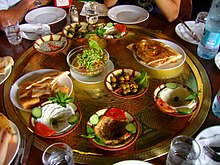
Lunch is considered the main meal of the mean solar day, and is traditionally eaten between 1:30 pm and 2:30 pm. Information technology is the repast for which the family unit comes together. Rarely practise meals have different courses; however, salads and mezze are served as side dishes to the main meal.
The platter ordinarily consists of a portion of meat, poultry or fish, a portion of rice, lentils, bread and a portion of cooked vegetables, in addition to the fresh ones with the mezze and salad.
The vegetables and meat are usually cooked together in a sauce (often tomato plant, although others are besides pop) to make maraqa , which is served with rice. Most households add together breadstuff.

Maraqa laga sameeyo khudaarta (Somali: "vegetable soup")
Drinks are not necessarily served with the food; however, in that location is a very wide variety of drinks such as shineena (or laban ), karakaden , Naqe'e Al Zabib, Irq Soos , Tamr Hindi , and fruit juice, as well every bit other traditional Arabic drinks.
During the 20th century, carbonated soda and fruit-based drinks accept also become very pop.
Dinner [edit]
Dinner is traditionally the lightest meal, although in modern times, dinner has go more important with regards to entertaining guests due to the hours of the workday.
Ramadan [edit]
Iftar [edit]
Iftar (also called Futuur ), or fast-breaking, is the meal taken at dusk when the fast is over. The repast consists of three courses: first, diners eat a date due to Islamic tradition.
This is followed by a soup or anything they would like, the most popular being lentil soup, merely a wide variety of soups such equally chicken, oats, freeka (a soup made from whole wheat and craven goop), spud, maash , and others are as well offered.
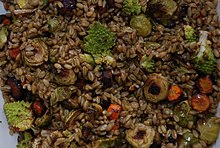
Freekeh with roasted vegetables
The 3rd course is the principal dish, usually eaten later on an interval, when Maghreb prayer is conducted. The principal dish is more often than not similar to what is served in lunch year-round, except that cold drinks are served.
Suhur [edit]
Suhur is the repast eaten just before dawn, when fasting must begin. It is eaten to help the person brand it through the day with enough free energy until dusk.
Sweets [edit]
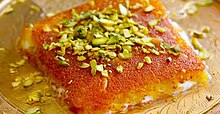
In addition to the two meals eaten during Ramadan (one for dinner and one for Suhur earlier dawn), sweets are consumed much more than usual during the month of Ramadan; sweets and fresh fruits are served between these two meals. Although almost sweets are made all twelvemonth-round such as kanafeh, baklava, and basbousa, some are made especially for Ramadan, such as qatayef.[12]
Arab hospitality [edit]
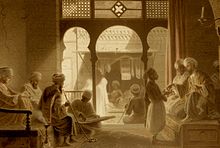
Coffeehouse in Cairo, 18th century
Essential to whatever cooking in the Arab world is the concept of hospitality and generosity. Meals are more often than not big family diplomacy, with much sharing and a great bargain of warmth over the dinner table. Formal dinners and celebrations generally involve large quantities of lamb, and every occasion entails large quantities of Arabic java or Standard arabic tea.

The different types of Arabic coffee with Hejazi/Najdi golden coffee seen on the left and the Levantine black qahwah sādah (plain coffee) on the correct
Khaleej [edit]
Coffee ceremony [edit]
In the Khaleej al-Arab region, a visitor is greeted by a dandy table of stale fruits, fresh fruits, basics and cakes with syrup. Dried fruits include figs, dates, apricots and plums. Fresh fruits include citruses, melons and pomegranate. Arabic java is most favored, but Arabic tea is likewise a slap-up refresher. Spices are often added to the coffee and other drinks.

Guests dinner [edit]
In the Khaleej al-Arab region, a guest should expect a dinner consisting of a very large platter, shared commonly, with a large corporeality of spiced rice, with spicy lamb, craven, or both, as separate dishes, with various stewed vegetables, heavily spiced, sometimes with a tomato-based sauce.
Different types of bread are served with toppings specific to the region. Tea would certainly back-trail the meal, as it is almost constantly consumed. Coffee would as well be served.

Dallahs for serving Arabic java
Maghreb [edit]
Tea/coffee ceremony [edit]
In the Maghreb region, a visitor will find a table full of bread-like snacks, including m'semen, baghrir, and other blimp breads. These are served with honey, rosewater or olive oil.
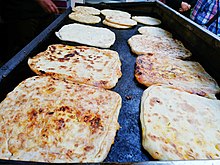
M'semen , usually served with honey, mint tea or java, can also be stuffed with meat
At that place are also many different cookies and cakes included accompanied by plates with dissimilar kinds of nuts. Mint tea is often served with information technology in a traditional Maghrebian teapot.
Dinner guests [edit]
In the Maghreb region, a guest may observe a table with unlike kinds of stews, called marqas or tajines. Dishes such as couscous and other semolina-based foods are also to be found.
These main dishes are accompanied past smaller mezze-like plates with salads, sauces and dips. Breads such every bit k'semen , khobz and baguette are used to eat the stews.

Tajine with lamb and mango
Levantine [edit]
Coffee/tea ceremony [edit]
In an boilerplate Arab Levantine household, a visitor might expect a table full of mezzes, breads topped with spices including za'atar and nuts. In the Levant, Arabic coffee is a much-loved potable, simply Arabic tea is also much enjoyed in Jordan and Palestine.
Dinner guests [edit]
In the Levant, a guest volition notice a table with dissimilar kinds of mezzes, nuts, dips and oils. Mezzes include hummus, baba ghanoush, falafel, kibbeh, kafta, smoked vegetables and tabouli salads. The nuts can differ from almonds to walnuts, with unlike spice coatings. The dips and oils include hummus and olive oil.
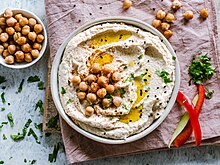
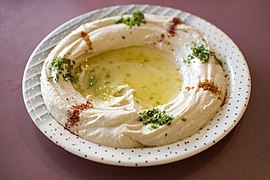
Hummus with chickpeas, sesame seeds, and oil
Regional differences [edit]
There are many regional differences in the Arab cuisine. For instance, mujadara in Syrian arab republic and Lebanon is dissimilar from mujadara in Jordan and Palestine. Some dishes, such equally mansaf (the national dish of Hashemite kingdom of jordan), are native to certain countries and rarely, if e'er, make an appearance in other countries.

Traditional mansaf served on flatbread
Unlike nigh Western recipes, cinnamon is used in meat dishes, too as in sweets such every bit baklava. Dishes such as tajine and couscous can differ from Morocco to Libya, each having their own unique preparation. Other dishes, such as the Andalucian-Moorish bastilla and albondigas accept different traditional spice mixes and fillings.

Bastilla , Moroccan meat pie
Many Arabic food words are borrowed from Aramaic, the language spoken past the Christian Nabataean inhabitants of Iraq and Syrian arab republic.[xi]
Regional Arab cuisines [edit]
Arabian Peninsula [edit]
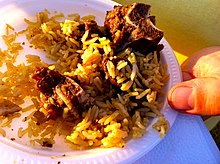

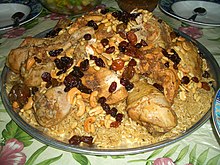
Eastern Arabian cuisine today is the effect of a combination of various influences, incorporating Levantine and Yemeni cuisines.[xiii]
Bukhari rice ( رز بخاري ) ( Ruz al Bukhari ) is a very popular dish eaten in the Hejaz district of Saudi Arabia. It is made with spicy tomato sauce, flavoured chicken and a fresh salad.
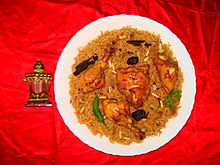
Kabsa is as well known as machbūs
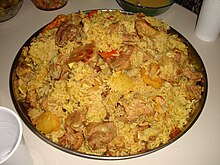
Kabsa ( كبسة ) or makbūs ( مكبوس ) is a traditional mixed rice originating from Kingdom of saudi arabia. It is made of rice (typically basmati), meat, vegetables, and a mixture of spices. Spices used in kabsa are generally black pepper, cloves, cardamom, saffron, cinnamon, dried lime (as well known every bit black lime), bay leaves and nutmeg.[fourteen] The meats used are usually chicken, goat, lamb, camel, beef, fish or shrimp. Kabsa is popular in countries effectually the Farsi Gulf and the Khuzestan Province of Iran.[ citation needed ]
The cuisine of Yemen is in some ways singled-out from other Arab cuisines. As in almost Arab countries, chicken, goat, and lamb are eaten more often than beefiness, and fish is eaten mostly in coastal areas.
Even so, cheese, butter, and other dairy products are less mutual, specially in the cities and other urban areas. Equally with other Arab cuisines, the nigh widespread beverages are tea and coffee; tea is ordinarily flavored with cardamom, clove, or mint, and coffee with cardamom. Karakaden , Naqe'eastward Al Zabib, and diba'a are the most widespread common cold beverages.
Although each region has their ain variation, saltah ( سلتة ) is considered the national dish of Yemen. The base is a brown meat is called maraq ( مرق ), a dollop of fenugreek froth, and sahawiq ( سحاوق ) or sahowqa (a mixture of chili peppers, tomatoes, garlic, and herbs ground into a salsa.)

Rice, potatoes, scrambled eggs, and vegetables are common additions to saltah . Information technology is eaten with flat bread known every bit mulawah, which serves as a utensil to scoop upwards the food.
Other dishes widely known in Republic of yemen include aseed, fahsa, thareed, samak mafi , mandi, fattah, shakshouka, shafut, bint al-sahn, kabsa, jachnun, harees and Hyderabadi haleem.[15] [16] [17]
Mashriq [edit]

Typical popular traditional Arab repast
Levantine cuisine is the traditional cuisine of the Fertile Crescent. Although at present divided into Syrian arab republic, Lebanon, Hashemite kingdom of jordan, Iraq, Egypt, and Palestine, the region has historically been more united, and shares many culinary traditions. Although very similar, there is some variation within the Levantine area.
Dishes include olive oil, za'atar, and garlic, and mutual dishes include a wide assortment of mezze or bread dips, stuffings, and side dishes such every bit hummus, falafel, ful, tabouleh, labaneh, and baba ghanoush.
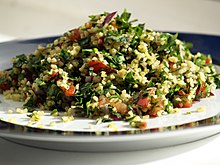
It also includes copious amounts of garlic and olive oil, oftentimes seasoned with lemon juice—almost no meal goes by without including these ingredients. Most frequently foods are either grilled, baked, fried, or sautéed in olive oil; butter and cream are rarely used, other than in a few desserts.
Vegetables are oftentimes eaten raw or pickled, as well as cooked. While the cuisine does not boast a multitude of sauces, it focuses on herbs, spices, and the freshness of ingredients.
Bedouin cuisine [edit]
The Bedouins of the Arabian Peninsula, Middle East and Northward Africa rely on a diet of dates, dried fruit, nuts, wheat, barley, rice, and meat. The meat comes from large animals such as cows, sheep, and lambs. They also eat dairy products: milk, cheese, yoghurt, and buttermilk (labneh).
Bedouins likewise use many different stale beans including white beans, lentils, and chickpeas. Vegetables that are ordinarily used are those that could be dried, such as pumpkins, but also vegetables that are more than estrus-resistant, such equally aubergines.
They drinkable a lot of fresh verbena tea, Arabic tea, Maghrebi mint tea, or Arabic coffee. A daily break to freshen up with drinks is a much-loved tradition.
Common breads in the Maghreb are khobz and khaleej . Traditional dishes such as marqa and tajines (stews) are also regularly prepared.
Breakfast consists of baked beans, breadstuff, nuts, dried fruits, milk, yoghurt, and cheese with tea or coffee. Snacks also include nuts and dried fruits.
Levant [edit]
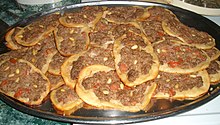
Sfiha comes from Baalbek, flatbread with a minced meat topping, often lamb
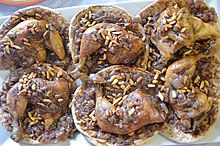
Musakhan, a Palestinian dish—craven with onions, spices and pine nuts on taboon breadstuff
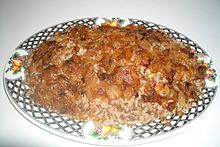

Mansaf, traditional lamb dish in yogurt sauce, served with rice or bulgur
In Palestine and Jordan, the population has a cooking style of their own, involved in roasting various meats, baking flatbreads, and cooking thick yogurt-like pastes from caprine animal'southward milk.
Musakhan is a mutual chief dish, famous in northern Jordan, the metropolis of Jerusalem, and northern West Bank. The main component is taboon bread, which is topped with pieces of cooked sweet onions, sumac, saffron, and allspice. For big dinners, it tin can be topped past one or two roasted chickens on a single large taboon breadstuff.
The primary cheese of the Palestinian mezze is Ackawi cheese, which is a semi-hard cheese with a balmy, salty taste and sparsely filled with roasted sesame seeds. It is primarily used in kenafah.
Maqluba is some other pop meal in Jordan and key Palestine. Mujaddara, another nutrient of the West Banking concern, as well equally in the Levant in general, consists of cooked green lentils, with bulghur sauteed in olive oil.
Mansaf is a traditional meal, and the national dish of Jordan, having roots in the Bedouin population of the country. It is more often than not cooked on special occasions such every bit Ramadan, Eid ul-Fitr, a birth, or a large dinner gathering.

A variant of mansaf in Amman, Jordan
Mansaf is a leg of lamb or large pieces of mutton, on top of a markook bread that has been topped with yellow rice. A blazon of thick stale yogurt fabricated from goat's milk, called jameed, is poured on top of the lamb and rice to requite it its distinct flavor and taste. The dish is garnished with cooked pine basics and almonds.
Levantine cuisine is also famous for its wide range of cheeses, including shanklish, halloumi, and arisheh .
Kishk is a famous Syrian soup, alongside many soups made of lentils. Lebanese food also has a broad range of dips including hummus, baba ganoush, and labneh, and offers many raw-meat dishes.
Syrian food tin be either extremely vegetarian or a meat lover's paradise. Lemon, oregano, za'atar, paprika, and various other Mediterranean spices and herbs are used in Syrian cuisine.
Levantine cuisine also incorporates wines fabricated in Lebanon, Syrian arab republic, Hashemite kingdom of jordan and Palestine and the Levantine equivalent of the Greek ouzo, known as arak.
Iraq/Mesopotamia [edit]
Iraq is home to the first cookbook ever recorded in history, historically in Baghdad and Mesopotamia. The Kitab al-tabikh is the oldest surviving Arabic cookbook, written by al-Warraq in the 10th century. It is compiled from the recipes of the eighth and 9th century courts of the Abbasid Caliphate in Baghdad. Due to its location, Iraq shares similarities in cooking and cuisines between both the surrounding regions of the Arab world too every bit Turkish and Farsi cuisine. Iraqi cuisine mainly consists of meat, rather than appetizers. In Iraqi cuisine, the most common meats are chicken and lamb. The national dish of Iraq is the Masgouf fish, usually enjoyed with grilled tomatoes and onions. Iraqi cuisine uses more than spices than most Arab cuisines. Iraq's main food crops include wheat, barley, rice, vegetables, and dates. Vegetables include eggplant, okra, potatoes, and tomatoes. Pulses such equally chickpeas and lentils are besides quite common. Common meats in Iraqi cuisine are lamb and beef; fish and poultry are likewise used.
Soups and stews are often prepared and served with rice and vegetables. Biryani, although influenced by Indian cuisine, is milder with a unlike mixture of spices, and a wider variety of vegetables, including potatoes, peas, carrots, and onions. Dolma is too i of the nearly popular dishes.
The Iraqi cuisine is famous for its extremely tender kebab, likewise every bit its tikka. A wide diverseness of spices, pickles, and amba are also extensively used.
Egypt [edit]
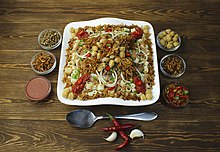

Falafel, deep-fried balls of ground chickpeas or fava beans, is a common dish in Egypt[eighteen] and the Levant.
Egypt has a very rich cuisine with many unique customs. These customs also vary inside Egypt itself, for example, in the coastal areas, like the coast of the Mediterranean Sea and Canal, the diet relies heavily on fish. In the more rural areas, reliance on subcontract products is much heavier. Duck, geese, chicken, and river fish are the principal fauna protein sources. While Egyptians eat a lot of meat, Egyptian cuisine is rich in vegetarian dishes; three national dishes of Egypt; ful medames, ta'miya (also known in other countries every bit falafel), and kushari, are generally vegetarian. Fruits are also greatly appreciated in Egypt: mangos, grapes, bananas, apples, sycamore, guavas, and peaches are very popular, especially because they are all domestically produced and are bachelor at relatively depression prices. A famous dessert from Egypt is called om ali , which is like to a bread and butter pudding fabricated traditionally with puff pastry, milk and nuts. It is served all across the Centre East and is also made on special occasions such equally Eid.[19] Staff of life is a staple in Egypt; the well-nigh mutual breads are eish baladi .
Africa [edit]
Sudan [edit]

In comparing to its Maghreb and Levantine neighbors, the cuisine of Sudan tends to be generous with spices. Sudanese cuisine has a rich variety in ingredients and creativity. Simple everyday vegetables are used to create stews and omelettes that are salubrious yet nutritious, and full of free energy and flair. These stews are chosen mullah . One could have a zucchini mullah , spinach ( riglah ) mullah , etc. Sudanese food inspired the origins of Egyptian cuisine and Ethiopian cuisine,[ citation needed ] both of which are very popular in the Western world. Pop dishes include ful medames, shahan ful, hummus, bamya (a stew made from basis, sunday-dried okra), and gurasa (pancake), besides as different types of salads and sweets.
Maghreb [edit]

Maghreb cuisine is the cooking of the Maghreb region, the northwesternmost part of the Arab globe along the Mediterranean Sea, consisting of the countries of Algeria, Libya, Kingdom of morocco, and Tunisia. In Maghrebi cuisine, the most mutual staple foods are wheat (for khobz bread[21] and couscous[22]),[23] fish, seafood, goat,[24] lamb,[24] beef,[24] dates, almonds, olives and various vegetables and fruits.[25]
Moroccan cuisine has long been considered i of the most various in the world. This is because Morocco has interacted extensively with the outside world for centuries. Over the centuries, chefs in Moroccan cuisine in Fes, Meknes, Marrakech, Rabat and Tetouan have been the footing for what is known as Moroccan cuisine today. Moroccan cuisine too ranked first in the Arab globe and Africa, and 2d in the world in 2012 after France.
Tunisian cuisine is the fashion of cooking used past the Tunisian people and is part of the Maghreb and Mediterranean cuisine. Assa on mush[ clarification needed ], spices, olive oil, chili red pepper, kodaid , wheat flour, lamb, garlic, fish and many other vegetables and spices are common. Tunisian cuisine offers what is known as a "solar kitchen" that relies heavily on olive oil, spices, tomatoes, fish species, and meat. Bread is an essential ingredient in Tunisian cuisine, as it accompanies almost all dishes and is usually used past dipping for broth.
Libyan cuisine derives much from the traditions of Maghreb and Mediterranean cuisines. 1 of the most popular Libyan dishes is bazin, an unleavened bread prepared with barley, water and salt.[26] Bazin is prepared by boiling barley flour in water and so beating information technology to create a dough using a magraf , which is a unique stick designed for this purpose.[27] Pork consumption is forbidden, in accordance with Sharia, the religious laws of Islam.[28] Tripoli is Libya'south uppercase, and the cuisine is particularly influenced by Italian cuisine.[28] Pasta is common, and many seafood dishes are available.[28] Southern Libyan cuisine is more traditionally Arab and Berber. Mutual fruits and vegetables include figs, dates, oranges, apricots and olives.[28]

Rechta is a Maghrebi dish of fine noodles, consumed particularly in Algeria and Libya and to a lesser extent in Tunisia and Morocco.
Libyan cooking, like Tunisian, includes hot spices. Typical foods are bazin (Libyan bread), bsisa, couscous, harissa, hassaa, lebrak (filled grape leaves with rice and minced meat), Libyan boureek , Libyan summertime salad, marqa or tajine, madrouba , and mbatten . Mbekbka is a unique Libyan soup with pasta or spaghetti—rather than draining off the h2o, pasta is boiled together with the sauce. It tin can be made with whatsoever type of pasta, and the simplest dish involves frying onions in oil, throwing in the tomato puree, chili powder, turmeric, then adding water and common salt and leaving to eddy earlier adding the pasta. Another way involves adding lamb chops, chickpeas and garlic to the sauce before serving hot with a sprinkle of extra virgin olive oil, lemon, fresh chili and optional crusty bread. Other vegetables such every bit pumpkin, potato and green pepper can be added.[ commendation needed ] Maglouba, shakshouka, sherba , usban, zumita and asida . Desserts and beverages include makroudh, Libyan tea, ghoriba, maakroun , mafruka and mhalbiya.
Algerian cuisine is characterized by a wealth derived from land and sea production, a Mediterranean-Maghreb cuisine. Information technology offers a diverseness of dishes depending on the region and season, which gives a very varied plate. This cuisine is notwithstanding based on vegetables and cereals that accept always been produced in abundance in the country, which was formerly called Roma bakery and and so Bakery Europe.[ commendation needed ] In improver, Algeria's rich history has contributed to the abundance of food from different periods and regions of the world. Among all the culinary specialties available in Algeria, couscous remains the most famous, recognized equally a national dish, also as the traditional pastry chosen Oriental pastry in Western countries. Despite its historical transmission from generation to generation, there are many books devoted to Algerian cuisine. Algerian cuisine combines a diversity of ingredients including vegetables, fruits, spices, meat, fish, seafood, vegetables and dried fruits. Vegetables are often used for salads, soups, casserole, couscous and sauces. Carrots, pumpkins, potatoes, greenish beans, beans, kale, eggplant, and truffles are widely used.
Gallery [edit]
- Dishes
-

-

-
-

-

-

-
-

-
-

-
-

See also [edit]
- List of Arab salads
References [edit]
- ^ Flandrin, Jean-Louis; Montanari, Massimo; Sonnenfeld, Albert; Botsford, Clarissa (1999). Nutrient: A Culinary History from Antiquity to the Present. New York: Penguin Books. ISBN0-231-11154-1.
- ^ Nasrallah, Nawal (2007). Annals of the Caliphs' Kitchens. Brill. pp. 121–122.
- ^ Nasrallah, Nawal (2007). Annals of the Caliphs' Kitchens. Brill. pp. 182–184.
- ^ The Oxford Companion to Sugar and Sweets
- ^ Nasrallah, Nawal (2007). Annals of the Caliphs' Kitchens. Brill. p. 129.
- ^ Nasrallah, Nawal (2007). Annals of the Caliphs' Kitchens. Brill. p. 221.
- ^ Nasrallah, Nawal (2007). Annals of the Caliphs' Kitchens. Brill. p. 220.
- ^ Nasrallah, Nawal (2007). Annals of the Caliphs' Kitchens. Brill. p. 229.
- ^ "The Ascension of Palestinian Food".
- ^ Nabeel Y. Abraham. "Arab Americans", Encarta Encyclopedia 2007. Archived 2009-ten-31.
- ^ a b Zaouali, Lilia (2007). Medieval Cuisine of the Islamic Earth. University of California Press.
- ^ "Desserts & Sweets in Arabia".
- ^ "Daily Traditional Gulf Cuisine food recipes". Shahiya.com. Retrieved 2016-01-07 .
- ^ "Al Kabsa - Traditional Rice dish". Food.com . Retrieved 23 June 2012.
- ^ "Hadhramaut continues to highlight Arabic presence in Malaysia - Civilization & Fine art - 13/12/2013". KUNA.net. 2013-12-13. Retrieved 2016-01-07 .
- ^ "KUNA : Hadhramaut continues to highlight Arabic presence in Malaysia - Culture & Fine art - 13/12/2013". 158.50.x.7. 2013-12-13. Retrieved 2016-01-07 .
- ^ Grace Chen (2012-07-07). "Middle Eastern restaurants thriving in Malaysia". The Star. Malaysia. Retrieved 2016-01-07 .
- ^ National Dish of Arab republic of egypt - Falafel
- ^ "Umm Ali Recipe - Egyptian Bread Pudding".
- ^ Shulman, Martha Rose (23 February 2009). "Couscous: Just Don't Telephone call It Pasta". The New York Times . Retrieved 12 June 2017.
- ^ Qarooni, Jalal (1996). Flat Staff of life Technology. Springer. pp. 84–. ISBN978-0-412-08111-viii.
- ^ Smith, Andrew (2013). The Oxford Encyclopedia of Nutrient and Drink in America. Oxford University Press. pp. 567–. ISBN978-0-nineteen-973496-2.
- ^ MacVeigh, Jeremy (2008). International Cuisine. Cengage Learning. pp. 273–. ISBN978-1-111-79970-0.
- ^ a b c "Due north African Cuisine." Archived 2016-04-03 at the Wayback Machine Jamaica Observer. Accessed June 2011.
- ^ Mourad, Mazouz. "The Momo Cookbook." Archived 2011-09-19 at the Wayback Automobile The Globalist. Accessed June 2011.
- ^ Rozario, P. (2004). Libya . Countries of the globe. Gareth Stevens Pub. p. forty. ISBN978-0-8368-3111-v.
- ^ Davidson, A.; Jaine, T.; Davidson, J.; Saberi, H. (2006). The Oxford Companion to Food. Oxford Companions. OUP Oxford. p. 1356. ISBN978-0-19-101825-1.
- ^ a b c d "Libya". Foodspring.com. Accessed June 2011.
External links [edit]
-
 Media related to Arabic cuisine at Wikimedia Commons
Source: https://en.wikipedia.org/wiki/Arab_cuisine
0 Response to "Is This Beef or Lamb in Standard Arabic"
Post a Comment